
Acne is not just a cosmetic nuisance—it’s an inflammatory skin condition that can scar permanently, trigger long-term pigment issues, and undermine the skin barrier when it’s treated too aggressively. Laser and light-based acne treatments can work, but they work best when they’re used for the right acne subtype, at the right time, and as part of a medically guided plan—not as a one-size-fits-all substitute for medical therapy.
At Cosmetic Injectables Center Medspa in Sherman Oaks, care is directed by Dr. Sherly Soleiman, MD, Founder & Medical Director, a Board-Certified Physician with 25+ years of medical experience and training, providing on-site, physician-led oversight across the full scope of medical spa treatments. Dr. Soleiman directs treatment protocols, oversees provider training and clinical standards, and remains responsible for safety, sterility, and complication management for all procedures performed within the practice.
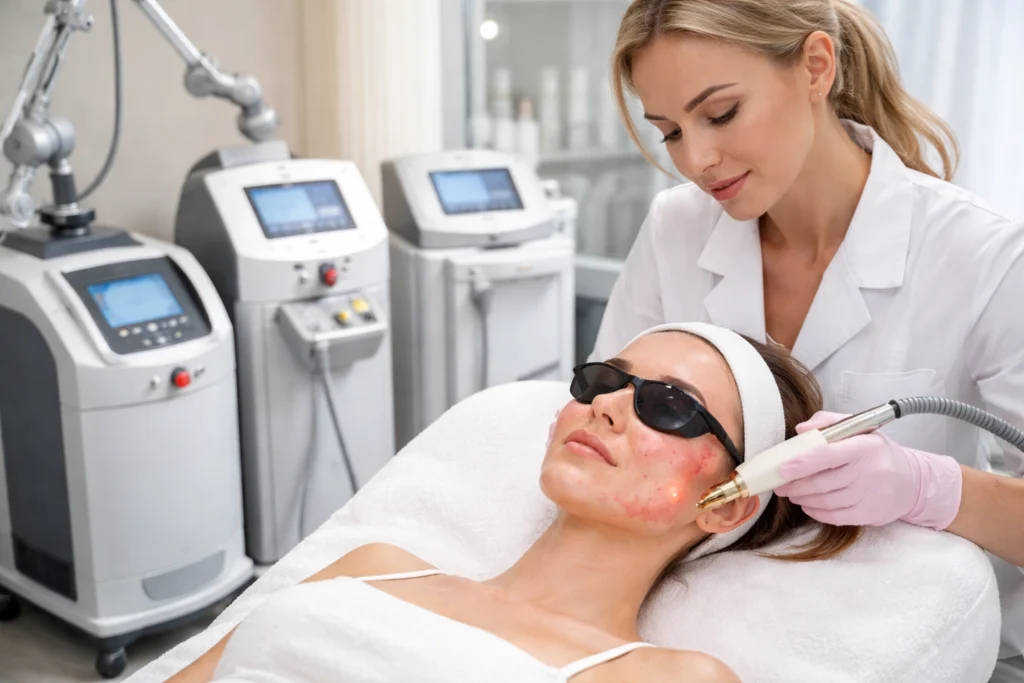
The honest answer: lasers can help acne—just not the way most people assume
When patients ask, “Do laser acne treatments actually work?” they’re often picturing a single device that “kills acne” permanently. That’s rarely the reality.
What lasers and light-based treatments can do well includes:
- Reduce inflammatory activity (red, tender bumps) in selected patients
- Decrease acne-related redness and lingering vascular inflammation
- Improve post-acne texture and early scarring patterns
- Support oil control and pore congestion in some skin types
What they typically do not do well as a standalone strategy:
- Cure hormonally driven acne without addressing hormones/medical drivers
- Clear severe cystic acne reliably by device treatment alone
- Prevent recurrence if comedones, skincare, bacteria/yeast imbalance, or hormones aren’t managed
The best outcomes come from matching the technology to the target: active inflammation vs. redness vs. pigment vs. scarring—and sequencing it properly.
Why “laser acne treatment” is a broad term (and why that matters)
A common pitfall is treating “acne” as one problem. Clinically, acne usually includes a mix of:
- Comedonal acne (blackheads/whiteheads; congestion-driven)
- Inflammatory acne (papules/pustules; immune/inflammatory-driven)
- Nodulocystic acne (deeper, painful lesions; higher scarring risk)
- Post-acne marks
- PIE (post-inflammatory erythema: red/pink marks)
- PIH (post-inflammatory hyperpigmentation: brown/gray marks)
- Acne scarring (atrophic rolling/boxcar/icepick patterns)
Different devices target different parts of that list. If the wrong device is used (or used at the wrong intensity), patients can spend months and money with minimal improvement—or trigger pigment problems that last longer than the acne itself.
What types of laser/light treatments are used for acne (and what each is best for)
1) Nd:YAG “laser toning” style treatments (often used for inflammation + redness support)
Devices in this category are commonly used to calm inflammatory pathways and improve diffuse redness and texture over time. In our practice, treatments such as Laser Genesis are typically positioned as adjunctive—helpful when acne has a strong inflammatory/redness component, or when patients can’t tolerate harsh topicals.
Works best when: acne is mild-to-moderate inflammatory, with background redness and early textural change.
Underperforms when: acne is primarily deep cystic/hormonal with ongoing new lesions.
2) IPL / broad-band light (often helpful for redness and discoloration—less so for “active acne” itself)
IPL isn’t a “laser,” but it’s frequently marketed alongside lasers. It can be useful when acne leaves behind persistent redness or discoloration, and when the patient’s skin type and timing are appropriate. Some patients do well with IPL photorejuvenation as part of post-acne mark management.
Works best when: acne is controlled but marks (especially redness) remain.
We avoid or delay when: there’s active, inflamed breakout activity and pigment risk is high.
If the main issue is lingering red or pink marks (PIE), vascular-targeting lasers can be more direct than “acne” lasers. They’re not primarily for comedones; they’re for the vascular signal left behind by inflammation.
Best for: persistent redness after acne, flushing tendency, and inflammation-related erythema.
Not ideal for: brown pigment (PIH) as the primary concern.
4) Fractional resurfacing lasers (primarily for acne scars, not active acne)
When patients say “laser for acne,” many are actually seeking help for acne scarring. Fractional resurfacing can be very effective for texture—but it should be timed correctly and performed conservatively in pigment-prone skin.
Best for: atrophic scars (rolling/boxcar), uneven texture, enlarged pores from scarring.
Not appropriate when: acne is still highly active (you end up “chasing inflammation” and risking prolonged healing).
5) RF microneedling (energy-based, often excellent for scars; not a first-line active acne treatment)
RF microneedling is not a laser, but it’s commonly part of an “acne laser” conversation because it can remodel acne scars and improve texture with different risk–benefit tradeoffs than resurfacing lasers. In our practice, Morpheus8 can be a strong option for the right scarring pattern and skin type—especially when we want collagen remodeling with careful downtime planning.
Clinical judgment that matters: when lasers help active acne—and when they don’t
Here’s the most practical way to think about it:
Lasers/light can help active acne when:
- Breakouts are mild to moderate inflammatory
- There’s significant redness/inflammation that lingers
- Skin is reactive and cannot tolerate strong retinoids/benzoyl peroxide
- The patient needs a strategy that supports consistency (rather than cycling through harsh products)
Lasers/light are usually not the right primary solution when:
- Acne is deep cystic or rapidly scarring
- Acne is strongly hormonal (jawline flares, cycle-related outbreaks) and not medically managed
- There’s untreated comedonal congestion (the “seed” of future inflammation)
- The patient is unwilling to follow strict post-treatment skin-barrier and sun-protection rules
A common “failure pattern” is using devices to calm inflammation while leaving comedones, skincare triggers, or hormonal drivers untouched—results look good briefly, then relapse.
Sherman Oaks–specific insight: sun exposure changes your laser acne strategy
In Los Angeles—including Sherman Oaks—patients have year-round UV exposure, and many maintain outdoor routines even when they say they “don’t sunbathe.” That matters because:
- Inflammation + heat + UV raises the risk of post-inflammatory hyperpigmentation (PIH) after energy-based treatments
- “Quick clearing” at high settings can backfire, especially in melasma-prone or pigment-reactive skin
- The safest plan is often lower intensity, more consistent sessions, paired with disciplined barrier care and daily tinted mineral sunscreen
This is one reason we’re conservative with settings and careful about timing—especially when patients are actively breaking out and already inflamed.
What kind of results should you realistically expect?
For active acne (properly selected patients)
- Early improvement can begin within a few sessions
- The goal is typically reduced frequency and severity, not “never breaking out again”
- Maintenance may be needed depending on the acne driver (oiliness, hormones, stress, skincare tolerance)
For red marks (PIE)
- Often improves more predictably than active acne itself—because we’re targeting a clearer endpoint (vascular redness)
For brown marks (PIH)
- Can improve, but requires more caution; treating pigment in inflammation-prone skin is where many patients get into trouble if they rush
For acne scars
- Meaningful change is absolutely possible, but it’s a series and a strategy, not a single “scar laser”
- Scar remodeling is measured in months, not days
Safety and candidate selection: who should be cautious
We slow down, modify settings, or sometimes avoid laser/light treatments when patients have:
- Uncontrolled cystic acne (higher risk of prolonged inflammation and marks)
- Very recent tanning or inconsistent sun protection
- A history of melasma or strong pigment reactivity
- Active skin barrier disruption (over-exfoliation, retinoid irritation, dermatitis)
- Certain medications or medical conditions that increase photosensitivity or impair healing
- A pattern of picking (excoriation) that keeps inflammation “alive”
Good candidates are not just “people with acne.” Good candidates are patients whose acne pattern matches the device goal—and who can follow aftercare precisely.
How we build an effective acne plan around lasers (instead of using lasers as a shortcut)
In a physician-led practice, devices are typically integrated into a broader plan that may include:
- A structured topical regimen focused on tolerance and consistency
- Strategic chemical exfoliation (when appropriate), such as chemical peels for congestion and tone—without over-stripping the barrier
- When scarring is a key concern, collagen remodeling approaches such as microneedling or RF-based remodeling
- For discoloration patterns that persist, targeted approaches like laser for pigmentation may be considered only when inflammation is controlled
Sequencing matters: we usually stabilize active inflammation first, then address marks, then treat scars—because scar treatments on actively inflamed acne tend to increase downtime and pigment risk without improving long-term outcomes.
A practical way to decide: “What am I actually treating?”
If you’re considering “laser acne treatment,” start with this question:
1) Is your main problem active breakouts?
- Consider inflammation-modulating light/laser as an adjunct, but don’t ignore comedones and medical drivers.
2) Is your main problem red marks that won’t fade?
- Vascular-focused energy devices often outperform “acne lasers” for this.
3) Is your main problem brown discoloration after acne?
- Proceed cautiously; pigment treatments require conservative settings and excellent sun discipline.
4) Is your main problem texture and scarring?
- Plan for collagen remodeling and resurfacing strategies—after acne is stable.
If you’re not sure which bucket you’re in, that’s exactly where physician evaluation prevents months of trial-and-error.
Aftercare that protects your results (and prevents setbacks)
Most disappointing outcomes are not due to the device—they’re due to what happens between sessions.
The non-negotiables:
- Strict sun protection (daily; not just “at the beach”)
- Gentle barrier care (avoid stacking acids, scrubs, or new actives immediately after)
- No picking (this is where PIH and scarring accelerate)
- Follow your provider’s plan on when to restart retinoids, acids, or acne prescriptions
In our Sherman Oaks patient population, the most common preventable issue is unintentional sun exposure during errands, school pickup, hiking, or outdoor dining—enough UV to prolong redness and trigger pigment even without visible sunburn.
FAQs
Do laser acne treatments permanently cure acne?
How many sessions do I need?
Can lasers make acne worse?
Are lasers safe for darker skin tones?
Should I treat acne scars while I’m still breaking out?
Is IPL the same as laser acne treatment?
What’s better: lasers or prescription acne treatment?
Bottom line
Laser and light-based acne treatments do work—when they’re used for the right indication and integrated into a medically guided plan. The patients who do best are the ones whose treatment is chosen based on acne type + pigment risk + lifestyle + scarring risk, not based on a device name.
For patients considering laser acne treatment, we recommend starting with a physician-guided consultation at Cosmetic Injectables Center Medspa at our Sherman Oaks location to build a plan that protects both short-term clearing and long-term skin quality.