
Choosing a laser for acne scars is not a “best device” decision—it’s a risk–benefit decision based on your scar architecture (shape and depth), your skin’s pigment behavior, and your tolerance for downtime. In our Sherman Oaks medical spa, the biggest determinant of satisfaction is not how aggressive a laser is—it’s whether the treatment plan matches the scar type and avoids predictable complications like post-inflammatory hyperpigmentation, prolonged redness, or texture mismatch.
Cosmetic Injectables Center Medspa is a physician-led medical spa in Sherman Oaks under the on-site leadership of Dr. Sherly Soleiman, MD, Founder & Medical Director, a Board-Certified Physician with 25+ years of medical experience and training. Dr. Soleiman directs treatment protocols and clinical standards across the full scope of nonsurgical medical aesthetic care, overseeing sterility, safety systems, provider training, and complication management for all procedures performed within the practice.
What follows is the framework we use clinically: scar type first, then laser category, then sequencing and combination strategy—because acne scarring is rarely a one-tool problem.
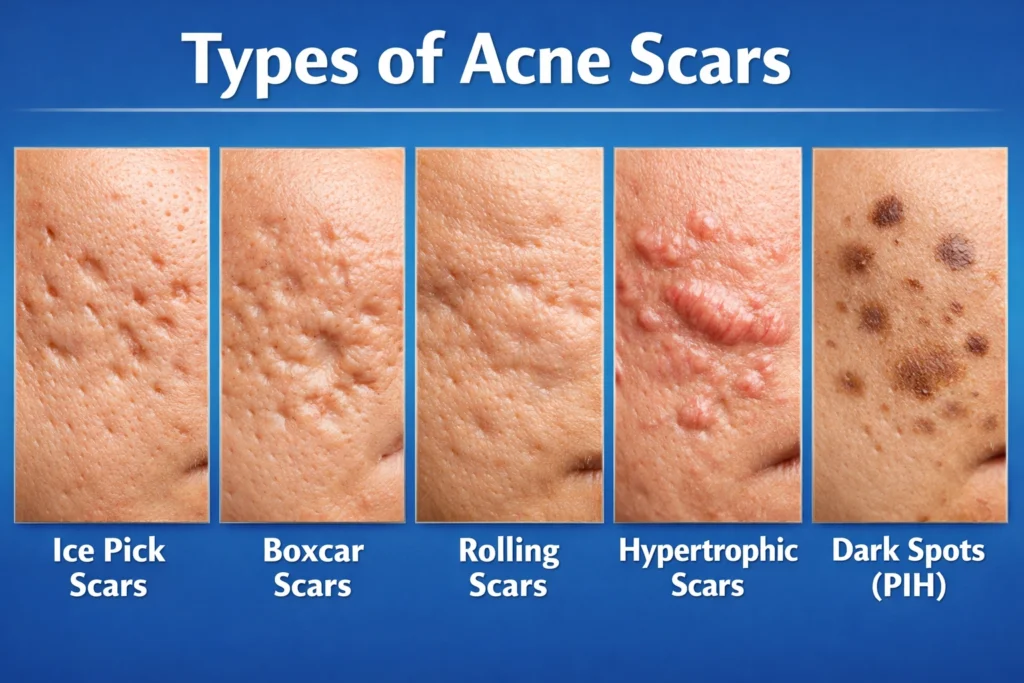
Medical Spa way to think about acne scars: texture vs. color (and why patients confuse them)
Most people use “acne scars” as a single term, but there are two separate issues that often travel together:
1) Texture scars (true scarring)
These are structural changes in collagen:
- Rolling scars (broad, shallow depressions)
- Boxcar scars (sharper-edged depressions)
- Ice pick scars (narrow, deep “punched” scars)
- Hypertrophic or keloid scars (raised scars)
Lasers can improve texture scars—but the correct laser depends on the geometry and depth.
2) Color changes after acne (often not true scars)
- PIE (post-inflammatory erythema): lingering red/pink marks
- PIH (post-inflammatory hyperpigmentation): lingering brown discoloration
These respond best to vascular and pigment strategies, not the same plan used for texture remodeling.
Key clinical point: If you treat “color” like “texture” (or the reverse), you can waste sessions—or create pigment problems.
The pre-treatment decision points that determine which laser is “best” for you
Before selecting a laser, we make several calls that materially change outcomes:
Active acne control comes first
If breakouts are ongoing, resurfacing can become a cycle of “treat scar → new breakout → new mark.” We typically stabilize acne activity before committing to aggressive collagen remodeling.
Skin type and pigment behavior are not an afterthought
Fitzpatrick skin type, history of melasma, and prior PIH shift laser choice and settings. “More aggressive” is not “better” when your skin is prone to dyspigmentation.
Sherman Oaks–specific insight: With year-round UV exposure in Los Angeles, we see more patients whose pigment is “quietly primed” to misbehave—especially if they’re outdoors regularly or driving often. That changes how we time treatments, how we pre-condition skin, and how conservative we are with heat-based parameters.
Downtime tolerance is a clinical variable
Ablative fractional resurfacing may be the right tool for a deep texture problem, but it’s not the right first move for someone who cannot tolerate visible healing.
Your scar “map” is usually mixed
Many patients have rolling + boxcar + a few ice pick scars, plus PIE or PIH. “One laser protocol” is rarely the correct plan.
Laser categories that matter for acne scars (only as much as you need to make a smart choice)
Fractional resurfacing lasers (texture remodeling)
These are the workhorses for structural scarring:
- Ablative fractional: removes microscopic columns of skin and heats deeper tissue for stronger remodeling; more downtime, more risk if poorly selected.
- Non-ablative fractional: heats columns without removing the surface; less downtime, typically less dramatic per session.
What patients should know: For true texture scars, fractional resurfacing is often the backbone of improvement—but it’s not equally effective for every scar shape.
Vascular / redness-focused lasers and light devices (PIE)
These target hemoglobin and help red/pink marks and persistent redness.
Pigment-focused lasers and light devices (PIH / sun damage overlay)
These target melanin and uneven tone. They can be very helpful—but pigment-targeting has to be chosen carefully in patients prone to PIH.
For tone and discoloration concerns, we often reference our pigmentation-focused laser approach here: https://cosmeticinjectables.com/procedures/laser/laser-for-pigmentation/
Scar Type 1: Rolling acne scars (broad, shallow depressions)
Rolling scars are typically caused by tethering (fibrous bands pulling the skin down) plus collagen loss. They can look worse in side lighting and often improve meaningfully with the correct strategy.
What works best (and why)
For rolling scars, the “best laser” is usually the one that creates distributed collagen remodeling across a broader area:
- Fractional resurfacing tends to perform well because it treats a field of texture rather than a single pit.
Many patients with rolling scars do well with a staged plan that uses resurfacing as the backbone. For an overview of resurfacing options and what downtime typically looks like, see: Laser Skin Resurfacing
What we avoid (common mistakes)
- Over-focusing on one deep spot when the scar is actually a “terrain” problem.
- Treating rolling scars with a pigment-only strategy; that improves color, not indentation.
Poor candidate scenario (realistic)
If you are actively tanning, inconsistent with sunscreen, or have poorly controlled melasma/PIH history, aggressive resurfacing can be the wrong first step—even if the rolling scars are significant.
How we sequence rolling-scar care
- Stabilize active acne and inflammation.
- Choose fractional resurfacing intensity based on pigment risk + downtime tolerance.
- Reassess at each stage—rolling scars often improve steadily over multiple sessions.
Clinical bottom line: Rolling scars often respond well, but the best outcomes come from consistent remodeling over time, not one overly aggressive treatment that triggers prolonged redness or pigment issues.
Scar Type 2: Boxcar acne scars (sharper-edged depressions)
Boxcar scars have more defined borders and can be shallow or deep. The sharper the edge, the more you’re dealing with a “step-off” that needs edge blending plus collagen rebuilding.
Clinical judgment that matters (boxcar scars are often under-treated or mistreated)
- Shallow boxcar scars can respond nicely to fractional resurfacing.
- Deep boxcar scars may improve, but they often need more sessions and careful parameter choices to avoid edge demarcation or patchy texture.
What works best
- Fractional resurfacing is frequently the primary laser approach because it can soften edges and stimulate remodeling.
- In patients who cannot tolerate extended downtime, non-ablative fractional approaches may be chosen, understanding that improvement is more gradual.
What tends to underperform
- “Gentle” tone-focused treatments alone. They can make the skin look brighter, but the shadowing from boxcar edges remains.
Risk and limitation to know upfront
Boxcar scars are where patients often expect a “fill-in” effect. Lasers remodel; they do not rebuild the skin to a pre-acne baseline. A good plan aims for:
- softer borders
- less shadowing
- smoother reflectivity in overhead and side lighting
Not “perfect.”
Scar Type 3: Ice pick acne scars (narrow, deep “punched” scars)
Ice pick scars are usually the most frustrating for patients—and the easiest to mishandle. They are narrow at the surface and deep in the dermis, which makes them structurally resistant to standard field resurfacing alone.
Clinical positioning (what’s true even if it’s not what people want to hear)
Most ice pick scars do not respond well to lasers as a standalone treatment.
Lasers can improve overall texture and skin quality, but expecting fractional resurfacing to “erase” true ice pick scars is one of the most common setup-for-disappointment scenarios in acne-scar care.
What lasers can do for ice pick scars
- Improve surrounding texture, pores, and the “halo” around scars
- Soften the visual contrast so individual pits look less stark
- Complement targeted scar techniques used for the deepest lesions
What we avoid
- Repeated aggressive resurfacing sessions trying to force a response from deep pits—this can increase risk (prolonged erythema, PIH) without proportionate benefit.
Who is most likely to be disappointed
- Patients whose primary concern is a small number of very deep pits and who are seeking complete correction with “laser only.”
Practical takeaway: Ice pick scars often require a multi-modality plan where laser plays a supporting role—valuable, but not the only tool.
Scar Type 4: Mixed acne scarring (the most common real-world pattern)
Most faces are not “one scar type.” A typical pattern might be:
- rolling scars on cheeks
- boxcar scars at lateral cheeks/temples
- a handful of ice pick scars
- background redness (PIE) or brown marks (PIH)
How we choose a “best laser” when scars are mixed
We choose the backbone based on what drives the visual problem:
- If the main issue is texture, fractional resurfacing is usually central.
- If the main issue is redness, we prioritize vascular strategies first or in parallel.
- If the main issue is brown discoloration, pigment strategy is prioritized—often before aggressive heat-based resurfacing in pigment-prone patients.
Why combination planning is not “doing more”
Combination planning is often doing less, more intelligently:
- Using the right tool for the right target reduces the temptation to “overcook” with one device.
- It also improves predictability—especially in patients with pigment risk.
For patients whose “scars” are largely discoloration plus mild texture, an IPL-based plan can sometimes be part of the pathway:
Common sequencing logic (example)
- Address active acne and inflammation.
- Improve redness/pigment enough that the skin is calmer and more uniform.
- Then do texture remodeling with fractional resurfacing (or vice versa if texture is severe and pigment risk is low).
- Reassess scar map and adjust.
Scar Type 5: Red acne marks (PIE) that patients call “scars” (but usually are not)
PIE is persistent redness after acne—often flat, but visually prominent.
What works best for PIE
Redness responds best to vascular-targeting lasers/light. In our practice, we often evaluate whether an Excel V–type approach or an IPL/M22-style approach is the better match for the pattern and skin type.
Relevant references for the kinds of vascular and multi-target laser strategies patients ask about include:
What we avoid
- Jumping straight to aggressive resurfacing when the primary problem is vascular redness. Resurfacing can sometimes prolong erythema in patients who already hold redness.
Sherwood Oaks–area patient pattern we plan around (implicit local insight)
In this region, many patients are managing redness while also living with frequent sun exposure and heat. That combination can keep vessels “active,” which is why we often plan PIE reduction as a series rather than expecting a one-and-done.
Limitation you should know
PIE can be stubborn. Improvement is common, but complete clearance depends on:
- baseline vascular reactivity
- concurrent rosacea tendency
- sun/heat exposure patterns
- consistent skin-care and sun protection
Scar Type 6: Brown marks after acne (PIH) and uneven tone overlay
PIH is melanin-based discoloration—often more noticeable in medium to deeper skin tones and in patients who tan easily.
Clinical judgment that matters (because PIH is easy to worsen)
Some lasers and aggressive heat settings can trigger more PIH in patients who are already PIH-prone. The “best” treatment is the one that improves pigment without provoking new pigment.
What tends to work best
- A pigment-focused strategy (device selection + conservative parameters) combined with smart pre- and post-care.
- In many patients, we treat tone first so that texture resurfacing can be done more safely and predictably.
For a focused discussion of pigmentation approaches, see: Laser for Pigmentation
What we avoid
- Treating PIH like sun spots without accounting for acne-driven inflammation history.
- Overlapping strong treatments too close together, especially during months when patients are more likely to get incidental sun.
Poor candidate scenario
If a patient cannot avoid sun exposure, is inconsistent with sunscreen, or is actively tanning, pigment-focused treatments become higher risk—and we often delay or modify the plan rather than push forward.
Scar Type 7: Raised acne scars (hypertrophic scars and keloids)
Raised scars behave differently than atrophic (indented) scars. They are driven by an overactive scar response, not collagen loss.
Clinical positioning (laser is not the primary tool for most raised scars)
For hypertrophic scars and keloids, lasers can play a role in:
- redness reduction
- texture softening in select cases
But lasers are not the primary approach for many true keloids, and aggressive resurfacing is often the wrong direction.
What we avoid (important)
- Ablative resurfacing over unstable or actively thickening keloids without a broader medical plan. That can worsen scarring in the wrong patient.
What “success” looks like
For raised scars, the goal is often:
- flatter contour
- less itch/tenderness
- less redness
- improved blend with surrounding skin
Not necessarily full normalization.
“Enlarged pores” and acne-scar texture haze: when patients don’t have classic pits
Some patients don’t have obvious rolling/boxcar pits, but they feel their skin looks:
- porous
- crepey
- uneven in reflectivity
- rough under makeup
These concerns often respond well to field remodeling when the candidate is appropriate.
For a resurfacing-centered overview that aligns with this pattern, see: Laser Skin Resurfacing
Important limitation: If texture is primarily from ongoing clogged pores/active acne rather than residual scarring, we treat the acne first or the benefit won’t hold.
How many sessions do you need? The honest answer by scar pattern
Session count is driven by scar type and how aggressively we can safely treat:
- PIE / redness: often a series; progress is typically visible as redness fades in stages.
- PIH / brown marks: can improve in a few sessions, but recurrence risk depends heavily on inflammation control and sun behavior.
- Rolling and boxcar scars: usually multiple sessions; improvement is cumulative and often more noticeable after several months as collagen remodels.
- Ice pick scars: lasers improve the “field,” but deepest pits often need additional targeted strategies to see meaningful change.
Clinically: We plan for improvement you can measure in photos under consistent lighting—not just “looks better today.”
Preparing for acne-scar laser treatments (what reduces complications)
Pre-conditioning is not optional in pigment-prone patients
If you have a history of PIH or melasma, we often recommend a structured plan before and after treatment. The goal is to reduce inflammatory pigment signaling and improve predictability.
Medication and skincare disclosure matters
Certain topicals, recent tanning, and some systemic medications can change risk. We plan around this rather than discovering it after a complication.
The two biggest controllables: sun and picking
- Sun exposure after treatment is a major driver of pigment issues.
- Picking at acne lesions (even small ones) can create new marks that undermine scar progress.
What to expect after treatment: normal vs. not-normal healing signals
Healing varies by device category and settings, but common expectations include:
- transient redness
- mild swelling
- dryness/flaking with resurfacing
- temporary darkening of pigment prior to shedding in pigment-focused treatments
When we want you to call us: blistering, escalating pain, spreading crusting, or redness that looks infected—these are not “powering through” moments.
Frequently asked questions (laser acne scars)
Can lasers remove acne scars completely?
Which scar type responds best to lasers?
Is laser safe for darker skin tones?
Should I treat redness or texture first?
Can I do laser if I still get acne?
How long until I see results for texture scars?
Will one session be enough?
The bottom line: “best laser” is the one matched to your scar geometry—and your skin’s risk profile
Acne-scar laser treatment works when it’s planned like medicine: correct diagnosis, conservative risk control, and staged remodeling—not trend-driven device selection. For patients considering laser treatment for acne scars, we recommend starting with a physician-guided consultation at our Sherman Oaks medical spa so your scar type, pigment risk, and downtime constraints can be assessed in person.